


Introduction
Artificial Intelligence is transforming modern devices — from smartphones and smart cameras to automotive systems and industrial equipment. At the heart of this shift is a specialized chip called an NPU, or Neural Processing Unit. To efficiently run AI models on these devices, manufacturers use this dedicated hardware, enabling faster processing, lower power consumption, and real-time performance.
What is an NPU?
A Neural Processing Unit (NPU) is a dedicated processor optimized for executing neural network operations such as image recognition, object detection, speech processing, and other AI-related tasks. Unlike traditional CPUs and GPUs, an NPU is built specifically to handle AI computations efficiently, making it ideal for edge devices where performance and power efficiency are critical.
Where a CPU excels at general-purpose tasks and a GPU handles parallel graphics workloads, an NPU focuses entirely on AI inference, delivering faster processing at lower energy consumption.
Key Features of an NPU
AI Acceleration
NPUs are specifically designed to accelerate artificial intelligence and machine learning workloads, enabling applications such as facial recognition, voice assistants, and object detection to run smoothly and accurately.
High-Performance Processing
With advanced parallel computing capabilities, NPUs can perform millions of calculations simultaneously, significantly reducing AI inference time and supporting real-time decision-making.
Low Power Consumption
One of the biggest advantages of NPUs is energy efficiency. They consume much less power than CPUs and GPUs, making them ideal for smartphones, wearables, and IoT devices.
Quantization Support
Modern NPUs support optimized data formats like INT8 and FP16, reducing memory usage and increasing execution speed while maintaining model accuracy.
On-Device AI Execution
AI models can run directly on the device instead of depending on cloud servers. This improves privacy, reduces latency, and enables offline AI functionality.
Multi-Framework Compatibility
Many NPUs support popular AI frameworks such as TensorFlow, PyTorch, ONNX, and TensorFlow Lite, simplifying deployment for developers.
What is NPU Deployment?
NPU deployment is the process of converting, optimizing, and running trained AI models on NPU hardware. The goal is to ensure maximum performance while maintaining low power consumption and high accuracy.
Since AI models trained on development platforms cannot usually run directly on NPUs, they must first be optimized and adapted to the target hardware architecture.
NPU Deployment Workflow
Step 1 — Model Training
The AI model is first developed and trained using frameworks such as TensorFlow or PyTorch.
Step 2 — Model Conversion
The trained model is converted into a format compatible with the target NPU platform.
Step 3 — Model Optimization
Optimization techniques such as quantization and pruning are applied to reduce model size and improve execution speed.
Step 4 — NPU Compilation
The optimized model is compiled using vendor-specific SDKs and toolchains, generating instructions that the NPU can execute efficiently.
Step 5 — Deployment and Integration
The compiled model is integrated into target applications like smart cameras, automotive systems, or industrial controllers.
Step 6 — Validation and Testing
The deployed model is tested for accuracy, latency, memory usage, thermal performance, and power consumption to ensure reliable operation.
Benefits of NPU Deployment
- Faster AI inference for real-time applications
- Lower power consumption for longer battery life
- Reduced latency through local processing
- Enhanced privacy by keeping data on-device
- Offline AI functionality without cloud dependency
- Improved overall system efficiency
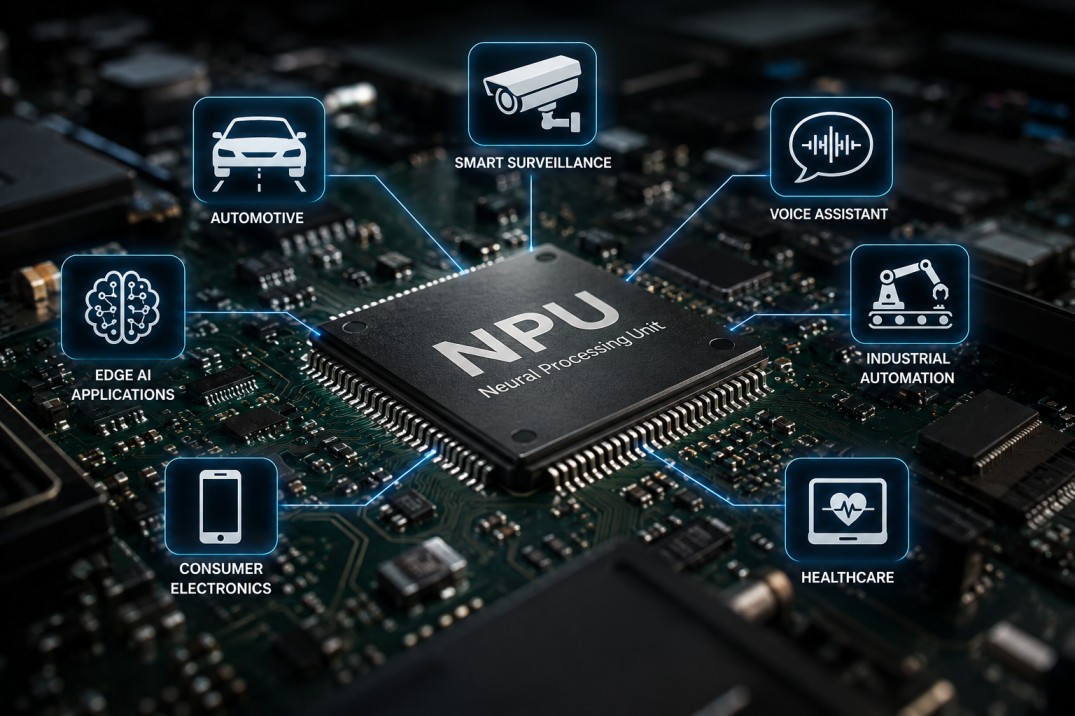
Applications of NPU Deployment
Automotive
Driver monitoring, lane detection, and object recognition systems.
Smart Surveillance
Face recognition and intrusion detection technologies.
Consumer Electronics
Voice assistants and AI-powered smartphone cameras.
Industrial Automation
Defect detection and predictive maintenance systems.
Healthcare
Medical image analysis and patient monitoring applications.
Conclusion
A Neural Processing Unit (NPU) has become a key technology for enabling efficient AI processing on edge devices. Its ability to deliver high performance with low power consumption makes it essential for modern AI applications. Through proper NPU deployment, organizations can optimize AI models for real-world environments while ensuring faster inference, improved privacy, reduced latency, and enhanced user experiences. As Edge AI continues to grow, NPUs will play an increasingly important role in powering the next generation of intelligent devices.